
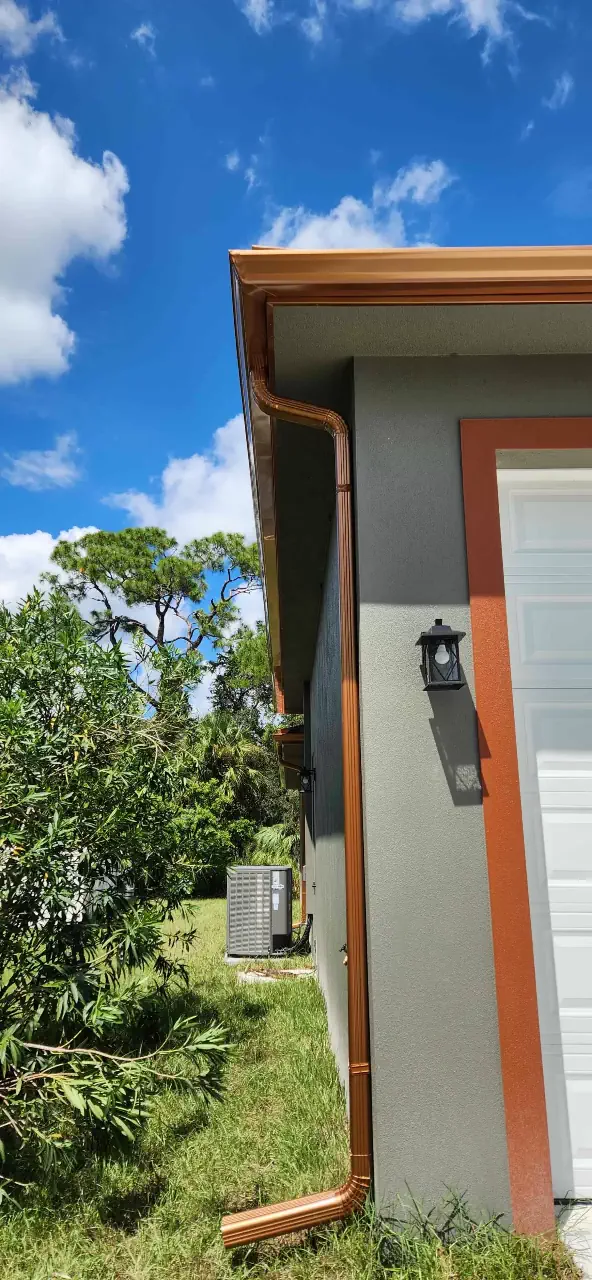
Few things are more frustrating than watching rain pour over the edge of your gutters, right onto your landscaping, your walkway or your front step. Gutters are supposed to catch that water and carry it away. When they overflow, the water ends up exactly where you don’t want it: against your foundation, behind your fascia and across your lanai.
The good news is that overflowing gutters almost always come down to a handful of causes, and every one of them has a fix. Here are the eight we see most often in Southwest Florida, and what to do about each.
Key Takeaways
- Gutters overflowing is often caused by clogs, insufficient downspouts, or undersized gutters.
- Regular maintenance includes clearing debris and installing micro mesh gutter guards to prevent clogs.
- Consider upgrading to larger gutters for better capacity, especially in heavy rain areas like Southwest Florida.
- Address issues like incorrect pitch or sagging sections to ensure proper water flow.
- Consult professionals for a free estimate to effectively resolve overflowing gutters issues.

Is it normal for gutters to overflow in heavy rain?
In a true cloudburst, when a tropical storm dumps rain faster than almost any system can move it, a brief spill at a corner or valley can happen. But if your gutters overflow in ordinary afternoon storms, or every time it rains hard, that isn’t normal. It’s a sign something in the system needs attention.
1. Clogged gutters
The most common cause by far. Pine needles, oak leaves, seed pods and shingle grit build up in the gutter until water has nowhere to go but over the edge. In Florida, trees drop debris all year, so gutters can fill faster than homeowners expect.
The fix: Clear the gutters, then keep them clear. Micro mesh gutter guards stop pine needles and grit from getting in at all. See how gutter guard types compare.
2. Clogged downspouts
Sometimes the gutter looks clear from the ground, but the downspout is packed with debris. Water backs up, fills the gutter and spills over, often right near the corner where the downspout connects.
The fix: Flush or clear the downspout. If it clogs again and again, it may be undersized. We install commercial-grade 3 × 4 downspouts that move more water and are harder to clog.
3. Not enough downspouts
A long gutter run with only one downspout has to carry a lot of water a long way. In a heavy storm, it simply can’t drain fast enough.
The fix: Add downspouts so each one handles a shorter section of roof. Spreading the load is one of the simplest ways to stop chronic overflow.
4. Undersized gutters
Many older homes have 5-inch gutters. They work in a light shower, but Florida downpours can deliver more water than a 5-inch gutter can hold, especially on larger or steeper roofs.
The fix: Upgrade the gutter size. We install 6-inch K-style gutters as standard because they hold more water than 5-inch gutters, and we also offer 7-inch and 8-inch K-style gutters for large roofs, steep roofs and areas that take extra runoff. Box gutters are another high-capacity option, often used on larger homes and commercial buildings. (More on choosing a gutter style below.)
5. Wrong pitch or sagging sections
Gutters need a slight slope toward each downspout. If they were installed level, or if a section has sagged over time, water pools in the low spots and spills over instead of draining.
The fix: Re-pitch or re-secure the gutter. If sagging keeps coming back, check the fascia board behind it. Soft or rotted fascia can’t hold fasteners. Read how to tell whether to repair or replace your gutters.
6. Roof valleys dumping water in one spot
Where two roof slopes meet, they form a valley that funnels a huge amount of water into a short stretch of gutter. Even a clean, properly sized gutter can be overwhelmed at that one point.
The fix: Put a downspout near the valley, use a larger gutter on that run, or both. This is one of the most common spots where upgrading to a 7- or 8-inch gutter makes a real difference.
7. Water shooting over the gutter
On steep roofs and metal roofs, rain can pick up so much speed that it overshoots the gutter entirely, landing on the ground in front of it. It looks like overflow, but the water never made it into the gutter in the first place.
The fix: A wider gutter catches more of that fast-moving water. Larger K-style and box gutters are often the answer on steep and metal roofs.
8. Water running behind the gutter
If water is dripping between the gutter and the house, the gutter may be mounted too low, or there may be a gap where the roof edge meets the gutter. This kind of “hidden overflow” is especially damaging because it soaks the fascia and soffit, where it can cause rot you won’t see until it’s advanced.
The fix: Have the gutter re-hung at the correct height and check the fascia for damage. Learn more about the signs of soffit and fascia damage.

Choosing the right gutter style for your home
Size and style both affect how much water your gutters can handle. Zeus Gutters installs seamless aluminum gutters in several profiles:
| Gutter style | What it’s best for |
|---|---|
| 6-inch K-style | Our standard for most Southwest Florida homes. More capacity than 5-inch gutters, with a clean, classic profile. |
| 7-inch K-style | Larger or steeper roofs, metal roofs, and runs below roof valleys. |
| 8-inch K-style | Very large roof areas and spots that take the heaviest runoff. |
| Box gutters | High-capacity, squared-off gutters often used on larger homes and commercial buildings. |
| Half-round gutters | A rounded, traditional look that suits certain architectural styles. For the same width, K-style gutters generally carry more water, so we’ll help you choose a size that keeps up. |
Every system is formed on site from a single piece of aluminum for each run, so there are no seams along the length to leak. It’s installed with hidden hangers, hand-mitered corners, and downspouts fastened with hidden clips and hurricane anchors. Learn more about our seamless gutter installation.
What overflowing gutters can damage
- Your foundation. Water spilling at the base of the wall can pool against the slab and stain or erode the area around it.
- Fascia and soffit. Water running behind the gutter soaks the wood and leads to rot.
- Landscaping and walkways. Overflow washes out mulch and beds and leaves stains on pavers and concrete.
- Lanais and pool decks. Overflowing pool cage and lanai gutters dump water where you sit and swim.
Frequently Asked Questions
Simply reach out to our team, and we’ll will swiftly craft a plan that will help you get the gutters you need!
Why do my gutters overflow even though they’re clean?
Usually because the gutters are too small for the roof, there aren’t enough downspouts, the pitch is off, or a roof valley is concentrating water in one spot. Upgrading to larger gutters or adding downspouts typically solves it.
Will gutter guards stop my gutters from overflowing?
If the overflow is caused by clogs, yes. Micro mesh guards keep debris out so water can flow. If the gutters are undersized or poorly pitched, guards alone won’t fix it, so we check the whole system first.
What size gutters do I need in Florida?
For most homes, 6-inch K-style gutters are the right starting point. Large or steep roofs, metal roofs and runs below valleys often benefit from 7- or 8-inch K-style or box gutters. We’ll recommend a size during your free estimate.
Do you offer half-round and box gutters?
Yes. Along with 6-, 7- and 8-inch K-style gutters, we install box gutters and half-round gutters.
Which areas do you serve?
Southwest Florida from Sarasota and Lakewood Ranch down to Naples, including Port Charlotte, North Port, Venice, Wellen Park, Punta Gorda, Cape Coral and Fort Myers. See our full list of service areas.

Need further assistance?
Need help finding the answers you need? Let’s have a conversation.
We’ll find out why your gutters are overflowing and recommend the fix that actually solves it, whether that’s a repair, more downspouts, gutter guards or a larger gutter. No pressure, no obligation. Request your free estimate online or call Port Charlotte at (941) 310-2222 or Cape Coral at (239) 888-2303.
Leave a Reply